Home » bankrutpcy

Category: bankrutpcy

Bankruptcy Filing May Signal the End of This Popular Restaurant Chain

Bankruptcy Filing May Signal the End of This Popular Restaurant Chain

Boston Market has long been an affordable chain restaurant that families can rely on for a convenient meal, especially if they like rotisserie chicken. However, the chain’s owner, Jay Pandya, filed a personal bankruptcy in the state of Pennsylvania on December 8, 2023. Pandya’s filing comes in the wake of numerous lawsuits from a variety of creditors. Vendors and franchisors are pursuing him for unpaid bills, and employees are pursuing him for unpaid wages. This can quickly become a business owner’s worst nightmare, especially with a company that has seen falling profits in recent years. Personal bankruptcy can shield Pandya from his creditors, who will need a motion for relief from the automatic stay if they wish to continue with a lawsuit while his bankruptcy is in good standing. Unfortunately, Boston Market’s story shows that people have less disposable income available for dining and this could result in many people losing their jobs. Personal bankruptcy can shield you from creditors and clear debts that you can’t afford to pay. To learn more about bankruptcy in Arizona, call 602-509-0955.

A gavel on a desk with a blurred lawyer behind it, representing legal action related to bankruptcy

How Boston Market Ended Up Here

This filing is only part of a long period of financial struggles for Boston Market. Pandya came to own Boston Market when his company, Engage Brands (under the Rohan Group of Companies) purchased it in 2020. Pandya also owns Yum Brands, which owns fast food companies like KFC, Pizza Hut, and Taco Bell. Yum Brands also used to own Long John Silver’s and A&W Restaurants. Pandya as an individual is a huge player in the fast food industry. But Engage Brands originally acquired Boston Market while it was in the midst of financial struggles and Yum Brands declared bankruptcy during the pandemic.

Boston Market’s legal and financial woes may have irreparably damaged its reputation as a business. In May 2023, Boston Market’s Denver headquarters were seized by local authorities. This seizure also included three restaurant locations in Aurora, Colorado. A distraint warrant, which allows the Department of Revenue to seize business assets and change the locks on the doors, was issued due to Boston Market’s back taxes and unpaid wages. The amount owed was reportedly about $300,000. They were able to settle the balance and reopen their Colorado doors. Just a few months later, Boston Market faced a similar issue in New Jersey. In August 2023, 27 Boston Market locations in New Jersey were shut down due to the chain’s failure to pay $630,000 in wages to 314 employees. The total unpaid wages, fines, and other fees came out to approximately $2.5 million. Over the past few years, Boston Market has closed several hundred locations and not opened any new ones. While Pandya’s bankruptcy is a personal one, his control over the company affects many people. It will be up to the court to decide, through his bankruptcy, if keeping Boston Market in business will be in the creditors’ best interests.

Examples of Successful Restaurant Bankruptcy Cases

Most businesses either file for Chapter 11 bankruptcy or Chapter 7 bankruptcy. Chapter 11 bankruptcy can be used to reformulate a business, emerge, and continue operating, or shut down. Chapter 7 bankruptcy only offers business debtors the choice to shut down. Many restaurants have used bankruptcy to deal with debts and creditors, with many of them being forced to do so due to the pandemic. Examples of restaurants that have previously declared bankruptcy include:

  • Chuck E. Cheese 
  • California Pizza Kitchen
  • Sizzler
  • Souplantation/Sweet Tomatoes
  • Ruby Tuesday
  • Bar Louie
  • Rubio’s
  • Cici’s Pizza

Personal Bankruptcy & Protection from Creditors

For the average person, filing for bankruptcy will be much simpler than the case of someone who owns Boston Market and other restaurant chains. But whether you file for Chapter 7 bankruptcy, Chapter 13 bankruptcy, or even Chapter 11 bankruptcy, it will activate the automatic stay. The automatic stay protects bankruptcy debtors from their creditors in a plethora of ways. 

Filing for bankruptcy can stop a creditor from filing a lawsuit and put one that has already been filed on hold. If the creditor has already obtained a money judgment against the debtor, it might qualify to be cleared by a bankruptcy filing. A creditor could use that money judgment to pursue a wage garnishment or bank account levy against the debtor, which will also be stopped by the automatic stay. The automatic stay also stops repossession and foreclosures. If you are concerned about an action a creditor may take against you and want to learn if bankruptcy will help, call 602-509-0955 for your free phone consultation.

How to Choose Which Chapter to File

There are different chapters of bankruptcy to suit different debt relief needs. Most of the time, individuals will be best off using Chapter 7 or Chapter 13. Chapter 11 can be an expensive and complicated ordeal and generally requires significant involvement from creditors in the form of a creditor committee. Small businesses can bypass the creditor committee through a small business or subchapter V filing. 

A major factor in the choice between Chapter 7 and Chapter 13 is income eligibility. Chapter 7 is the most commonly filed form of consumer bankruptcy but has strict income limits. A debtor whose household income exceeds the state median for their family size will need to qualify for Chapter 7 bankruptcy through the means test. Because Chapter 13 pays off debts in a payment plan, debtors can have a higher income and still qualify where they might not qualify for Chapter 7. It also allows debtors to keep assets that might not be protected by bankruptcy exemptions in Chapter 7. 

When you’re behind on the payments for a secured asset (like your house or car) that you wish to keep, chapter 7 bankruptcy might not be as useful to you as Chapter 13. Chapter 7 bankruptcy will only stop a repossession or foreclosure for a few months if the debtor can’t become current on their past-due balance. Chapter 13 can make it more affordable by essentially spreading that amount out over several years. A creditor will usually have no cause to proceed with a foreclosure or repossession after the successful completion of a Chapter 13 bankruptcy. 

Countless factors can impact which type of bankruptcy will be more effective in your situation. Our skilled Arizona bankruptcy lawyers can walk you through them, free of charge, with your initial phone consultation. To schedule yours today, call 602-509-0955. 

Arizona Bankruptcy Lawyers with High-Quality and Caring Service

A bankruptcy filing from someone like the owner of Boston Market shows that unmanageable debt can happen to anyone. Skillful bankruptcy representation can clarify the process and reduce the risk of obstacles and delays. An accurate bankruptcy filed in compliance with Arizona and federal bankruptcy law will result in a less stressful overall experience. Our bankruptcy attorneys have years of experience representing clients all across the valley and in Tucson. We offer flexible payment plans and you may even qualify to file for zero dollars down. To learn more about the services we offer at Phoenix Bankruptcy Lawyers, call 602-509-0955 to schedule your free consultation. 


Phoenix Bankruptcy Lawyers

668 N. 44th St. Set 320
Phoenix, Arizona 85008

Phone: (602) 509-0955
Pandemic Relief Protections In Bankruptcy Extended By House Of Representatives

Pandemic Relief Protections In Bankruptcy Extended By House Of Representatives

Coronavirus Aid, Relief, and Economic Security Act Bankruptcy Protections Have Been Extended

With widespread vaccinations on the horizon, the coronavirus pandemic may finally be drawing to a close in the foreseeable future. However, there is likely to be an economic aftershock that will be felt for years to come. To mitigate these negative effects, lawmakers passed the Coronavirus Aid, Relief, and Economic Security (CARES) Act on March 27, 2020. Now, these protections have been extended until March 27, 2022, by a majority vote in the House of Representatives. The bill, which was approved by a vote of 399-14, now heads to the Senate.

Coronavirus Aid, Relief, And Economic Security Act Bankruptcy Protections Have Been Extended In Arizona

CARES Act Bankruptcy Protections

One of the major parts of the CARES Act were stimulus payments for eligible Americans. Generally, those who make $75,000 or less as an individual or $150,000 or less combined as a married couple qualify for stimulus payments. Especially for the millions of Americans who lost their jobs or had their income reduced due to the pandemic, these stimulus checks can be a godsend. However, they are more effective when used to pay living expenses rather than to pay off debt. If someone already has a debt problem that has been aggravated by the pandemic, stimulus checks are at most a temporary bandage over a deeper issue. That’s why pandemic benefits like stimulus checks and increased unemployment benefits are generally exempt in bankruptcy. They do not count as income for bankruptcy qualification purposes, and trustees can’t seize them to pay towards the bankruptcy estate.

The CARES Act provided additional flexibility for bankruptcy filers. The debt limit for the small business provision of Chapter 11 was increased from $2.7 million to $7.5 million. The CARES Act guarantees that bankruptcy filers will still be eligible for mortgage forgiveness, eviction moratoriums, and exempt from utility shutoffs. It also allows those in an active Chapter 13 to apply for a financial hardship reorganization. These bankruptcy protections are among those that have been extended until March 27, 2022.

Types of Consumer Bankruptcy In Phoenix, Arizona

If the guarantee that further pandemic stimulus payments are exempt from bankruptcy makes you feel more confident about filing bankruptcy, it’s time to decide which chapter to file.

For those who have lost income due to the pandemic, the silver lining may be that they now qualify for Chapter 7 bankruptcy. Chapter 7 bankruptcy is a liquidation bankruptcy only available to those under certain income limits. Only those who make less than their state’s median income based on family size, or pass the Means Test, can file Chapter 7. The filer can only keep their assets if they are protected by state bankruptcy exemptions, or if their state allows them to use applicable federal exemptions. While the limitations in Chapter 7 are strict, the benefits it provides are significant. Most unsecured debts, such as credit cards, medical bills, and personal loans, are discharged in Chapter 7. The process generally only takes between 4 and 6 months. Once debts are discharged, the debtor can move forward with a fresh financial slate, and take steps to rebuild their credit.

Chapter 13 bankruptcy is a payment plan that lasts 3-5 years. The plan will last 3 years for those who make less than their state’s median income, and 5 years for those who make more than their state’s median income. The plan will be organized based on the types and amounts of debts, and the debtor’s disposable monthly income. Debts will be paid in an order of four different categories, starting with legal and trustee fees and ending with unsecured debts like medical bills and credit cards. These debts can be discharged at the end of the payment plan, even if they aren’t paid in full. The debtor will be protected from creditors by the Automatic Stay for the entire 3-5 years, with limited exceptions.

Chapter 7 and Chapter 13 have similarities in requirements and benefits. The person seeking to declare bankruptcy must file a petition- a long and detailed legal document describing the debtor’s financial situation- in the appropriate jurisdiction. This petition will be reviewed by an attorney appointed to their case known as a trustee. Debtors must complete two credit counseling courses in both chapters, one before filing and one within the 341 hearing. Both chapters require the debtor to attend a hearing known as a 341 Meeting of Creditors. Filing either chapter activates the Automatic Stay, which stops most forms of creditor collection. This includes wage garnishments, bank levies, foreclosures, repossessions, utility shutoffs, and more.

There are reasons besides income restrictions and asset exemptions that someone might choose to file Chapter 13 bankruptcy instead of a Phoenix Chapter 7 bankruptcy. There are mandatory waiting periods between bankruptcy filings, which are generally shorter when the subsequent bankruptcy is a Chapter 13. This can make Chapter 13 the only option for someone facing an emergency situation like a foreclosure or repossession. If someone is behind on child support and other nondischargeable debts, Chapter 13 will allow an opportunity to catch up on these payments where Chapter 7 would not. Chapter 13 also allows for the opportunity to discharge secondary home mortgages, and provides a far longer Automatic Stay period.

Contact Our Phoenix Bankruptcy Attorneys For Assistance

Are you struggling financially because of the pandemic? Bankruptcy may be a viable solution to your financial issues, and the extension of the CARES Act bankruptcy protections acknowledges that. However, filing your bankruptcy incorrectly could create more hassles like extra fines, asset seizures, and even dismissal. This will cost you in legal fees, and your debts will remain with you. An experienced bankruptcy attorney in Phoenix will help you avoid these potential pitfalls. Whether it’s calculating your disposable monthly income, determining your eligibility, drafting your petition, dealing with your creditors, and more, our staff and attorneys are here to help. To learn more about the benefits of filing bankruptcy with our firm, as well as our flexible payment options that will get you filed for as low as $0 down, schedule your free consultation today. Our Phoenix Bankruptcy attorneys can help.

Contact our Phoenix Bankruptcy Law office or use our online form to request your free phone consultation.


Phoenix Bankruptcy Lawyers

668 N. 44th St. Set 320
Phoenix, Arizona 85008

Phone: (602) 509-0955

business bankruptcy in Arizona due to Covid-19 blog

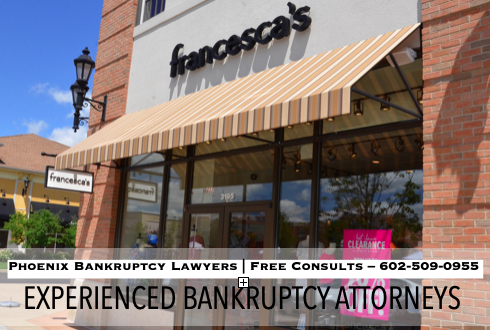
Fashion Retailer Francesca’s Files Chapter 11 Bankruptcy

Our Phoenix Bankruptcy Attorneys Discuss the Many Businesses Facing Bankruptcy Due to Covid-19

business bankruptcy in Arizona due to Covid-19 blogThe coronavirus pandemic continues to wreak havoc on the global economy as we draw closer to the end of the year. While unemployment rates have since stabilized, unemployment had reached levels comparable to those during the Great Depression. With millions of Americans experiencing a decrease in income in 2020, among the lowest of people’s priorities are fashion, accessories, and jewelry. Major clothing retailers declaring bankruptcy has become almost a daily occurrence. The latest to join these ranks is Francesca’s, a boutique-style fashion chain that can be found at many shopping malls.

More Information About Francesca’s

Francesca’s was founded in 1999 in Houston, Texas, where it is still headquartered. The brand has approximately 700 stores in the United States, about half of which are located in shopping malls. Like many other retailers, Francesca’s was forced to close in March 2020, and some of these closures have become permanent. Francesca’s originally announced that it would be permanently shutting down 140 of its locations. After declaring Chapter 11 bankruptcy on December 3, 2020, it has amended the store closures amount to include 97 additional locations, bringing the total to 237 store closures. The closures are expected to be completed by the end of January 2021.

Out of the 237 Francesca’s locations that are closing, two of them are located in Arizona. The chain’s Flagstaff and Glendale locations are among those to be closed by the first month of 2021. Arizona shoppers looking for holiday gifts may want to consider visiting these stores and Francesca’s website for liquidation sales.

A Brief Overview of Chapter 11 Bankruptcy

Chapter 11 bankruptcy is far more complicated than Chapter 7 and Chapter 13, the two most common types of bankruptcy that your friends or family members may have filed. In turn, attorney’s fees, filing fees, and other bankruptcy-related expenses are much higher in a Chapter 11, so this type of bankruptcy is typically only used by organizations and individuals with millions of dollars in assets and liabilities. However, there are Chapter 11 small business provisions for companies that aren’t as affluent.

Usually, a company will have a fairly good idea of what their strategy is to restructure debts and emerge from the bankruptcy. The company must submit a proposal of how to do so, and submit it to a panel of their top creditors. The creditors will then vote on the proposal. If the panel approves the proposal, the bankruptcy will proceed according to plan as long as it is also approved by the court. If the panel doesn’t vote to approve the company’s proposal, they may submit their own.

Other Types of Bankruptcies Available to People in Phoenix

As mentioned above, the two most common types of bankruptcy are Chapter 7 and Chapter 13. Chapter 7 is available to certain types of businesses, and both are available to individual filers. A trustee is assigned to oversee each type of case, and filers of both chapters are required to complete credit counseling courses and attend a hearing known as a 341 Meeting of Creditors.

Chapter 7 is known as a liquidation bankruptcy because it discharges most debts without any repayment. For that reason, there are strict income eligibility limits for Chapter 7. There are also limits on how much equity filers can have in their assets, which are known as “exemptions.” A Chapter 7 bankruptcy typically takes about 4-6 months from the date of filing to be discharged.

CONTACT USChapter 13 is also called a wage earner’s bankruptcy because this type of bankruptcy only works when the debtor has a steady source of income. If a debtor has too much income to qualify for Chapter 7, but still is struggling to manage debts, Chapter 13 is a 3-5 year debt reorganization payment plan. However, there are debt limitations for Chapter 13 filers- $419,275 for unsecured debts, and $1,257,850 for secured debts. It also allows filers to pay down debts that can’t be discharged in Chapter 7, like mortgage and car payment arrearages, child support, and student loans. A Chapter 13 plan lasts 3 years for filers who make less than the state median income for their family size, and 5 years for those who make more than that amount.

Francesca’s Bankruptcy Plan

Like many struggling businesses with a heavy focus on brick and mortar sales, one of Francesca’s top creditors is Simon Property Group. One of Francesca’s other lenders, Tiger Finance, has provided $25 million in financing to help the company with fees associated with breaking leases for the locations that are closing. Francesca’s plans on finding an investor to sell to as part of the bankruptcy process. Some companies convert creditors’ balances into ownership shares, but Francesca’s debt to asset ratio was too high to make this plausible.

Other Companies to Declare Bankruptcy During the Pandemic

Francesca’s is far from the first major business to declare bankruptcy as a result of the coronavirus pandemic. Fashion has been one of the hardest hit industries, with Neiman Marcus, JCPenney, J. Crew, Men’s Wearhouse, Brooks Brothers, Ann Taylor, Lane Bryant, True Religion, Lucky Brand, and Stein Mart have all declared bankruptcy in response to the pandemic. Home retailers like Pier 1 Imports, Sur La Table, and Land’s End have all sought bankruptcy protections in 2020 as well. Another hard hit industry, fitness, includes bankruptcy filers like Gold’s Gym, 24 Hour Fitness, and GNC. Restaurants are also struggling, with Sweet Tomatoes, California Pizza Kitchen, Chuck E. Cheese, Rubio’s Coastal Grill, Ruby Tuesday, Sizzler USA, and more filing their bankruptcy petitions.

Only a few of these businesses will be closing down for good as a part of their bankruptcies, but many will be downsizing by closing locations. This only adds to the compounding unemployment problem, leaving less people with income to spend at struggling businesses. However, most businesses that seek out Chapter 11 bankruptcy protection have a plan to revamp their business model and emerge a more efficient and profitable company. With widely available coronavirus vaccines on the horizon but government protections and benefits expiring soon, it is hard to say which of these businesses will survive in the long run.